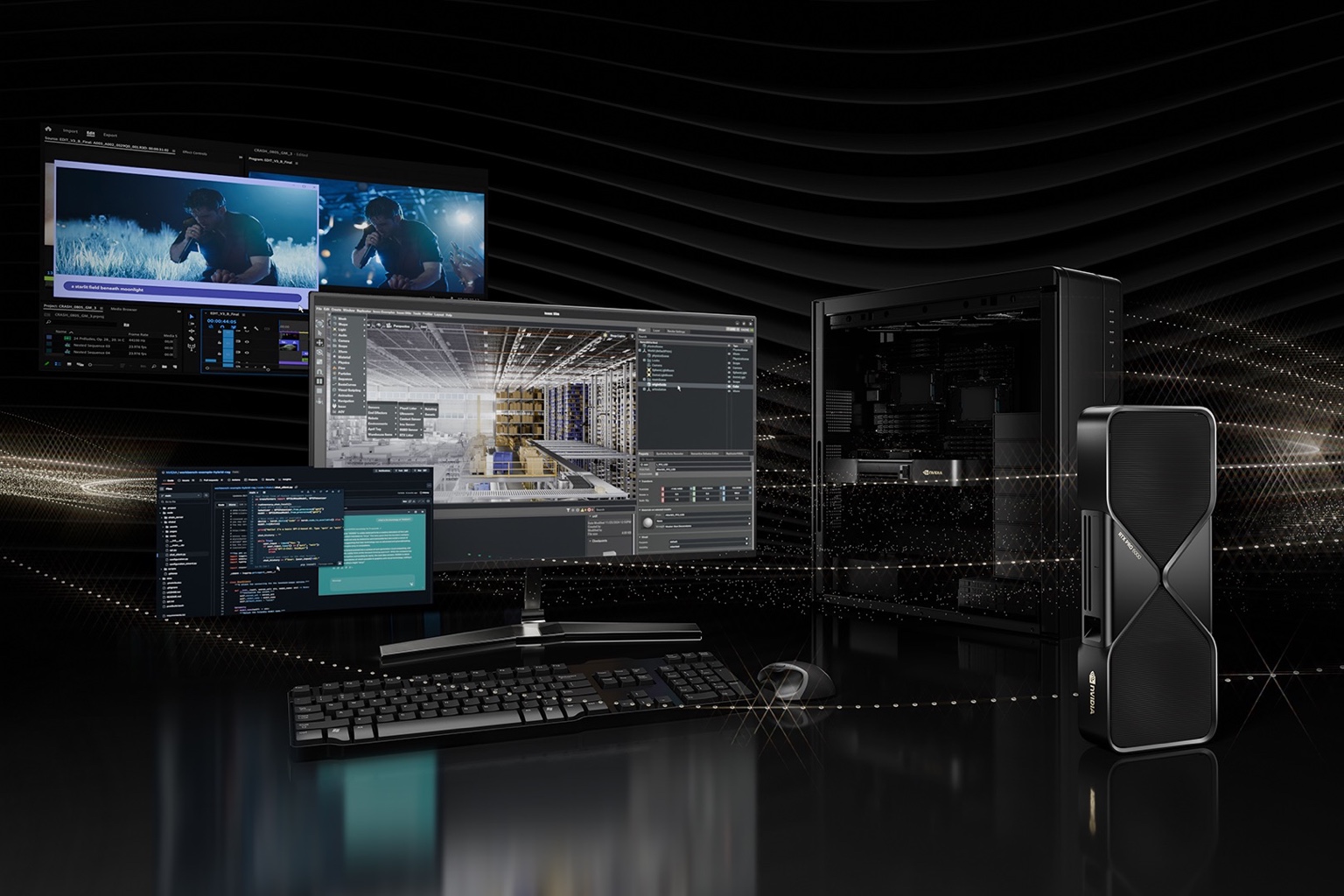
An RTX desktop is the fastest practical local AI path when the model fits in GPU memory and the workflow benefits from CUDA. Consumer cards deliver strong throughput for 7B–32B language models, image generation, speech, embeddings, and modest fine-tuning.
The RTX PRO 6000 Blackwell Workstation Edition moves the single-GPU memory ceiling to 96 GB of GDDR7 ECC and 1,792 GB/s bandwidth. It is professional hardware with professional price, power, cooling, and system-design requirements.
Choose a consumer RTX desktop for throughput per dollar
A 24–32 GB GPU is a productive local AI workstation for medium language models, Stable Diffusion-style image generation, transcription, vision models, and development. System RAM can offload part of a larger model, but performance often falls sharply once the active workload leaves fast VRAM.
Budget for the complete system: a power supply with headroom, a chassis that fits and cools the card, sufficient system RAM, fast storage for checkpoints, and an operating system supported by the runtime.
Choose RTX PRO 6000 when the workflow earns it
The 96 GB memory pool can host large quantized language models on one high-bandwidth GPU, while ECC memory and professional drivers suit longer-running and high-consequence work. NVIDIA lists 4,000 theoretical FP4 AI TOPS and four encoders and decoders, making the card relevant beyond text models.
The Workstation Edition can draw up to 600W and uses a double-flow-through design. Cooling and adjacent-card placement are system requirements, not accessories. Professional workstation pricing means utilization and support needs should be explicit before purchase.
A buying checklist
List the exact models, formats, context lengths, concurrency, and software stack. Confirm each fits with operational headroom. Estimate weekly hours of use, compare equivalent API or rented GPU cost, and include power and maintenance.
- VRAM capacity with 15–25 percent headroom.
- Memory bandwidth for decode and training throughput.
- CUDA and library compatibility for the actual workflow.
- Power, cooling, noise, physical fit, and warranty.
- Whether one large GPU is preferable to multiple smaller devices.
Buy the system for a measured workload, not for an AI TOPS headline.
Primary sources